Introduction.
Ethnic Vietnamese living in Cambodia represent the largest stateless group of people anywhere in the world. Many have lived in Cambodia for generations. Others came there on their way to escape Vietnam in 1975. Yet their plight is almost completely unknown — and the world is largely unaware of their sufferings.
As stateless people, ethnic Vietnamese have no rights in Cambodia. They cannot own land. They cannot have access to public healthcare or social services. They cannot find employment in the open economy. The children — even those born in Cambodia — cannot attend public school. Those able to go to school cannot get their diplomas, attend the university, or apply for a job.
Without rights, ethnic Vietnamese subsist mainly in the "underground economy" — working in restaurants and the sex industry in the major cities.
Without rights, other ethnic Vietnamese live on floating villages scattered throughout Tonle Sap Lake, and rely on fishing as their only way to survive.
In 2015, CNN exposed Svay Pak as the child prostitution capital of the world. Svay Pak is an ethnic Vietnamese neighborhood on the outskirts of Phnom Penh. The children sold on the streets of Svay Pak were mostly Vietnamese.
In 2017, the ethnic Vietnamese made headlines again when those living in the floating villages — many for three generations — were forcibly evicted from the Lake. They had nowhere to go. Where they eventually and temporarily docked their boats, there was no road, no water, no medical clinic, and no school. The policy of eviction without proper resettlement was inhumane.
And the ethnic Vietnamese are not recognized or wanted by Vietnam.
So it's up to us. People like us. And NGOs to do what we can.

The 2019 mission.
With a team of 45 strong — 16 healthcare professionals and their support staff — the Cambodia Medical Mission 2019 was a mission in the best tradition of service and collaboration on a scale this region had never seen before.
Our robust medical team consisted of 2 cardiologists, 1 pain specialist, 1 GI, 1 OB/gyn, 1 pediatrician, 1 family medicine, 1 ophthalmologist, 1 optometrist, 4 dentists, and 3 pharmacists. Our Vietnamese-speaking medical team was supported by 4 American military officers — some of whom served in the Vietnam War — and 10 students. The mission was closure for some team members, a new beginning for others, all with dedication and commitment to serving others in their hearts.
We brought with us over $50,000 of medicine and supplies and over 1,000 pairs of glasses to distribute at no cost to the patients. Most of the medicine and supplies were donated by AmeriCare, MAP International, and KNL Foundation.
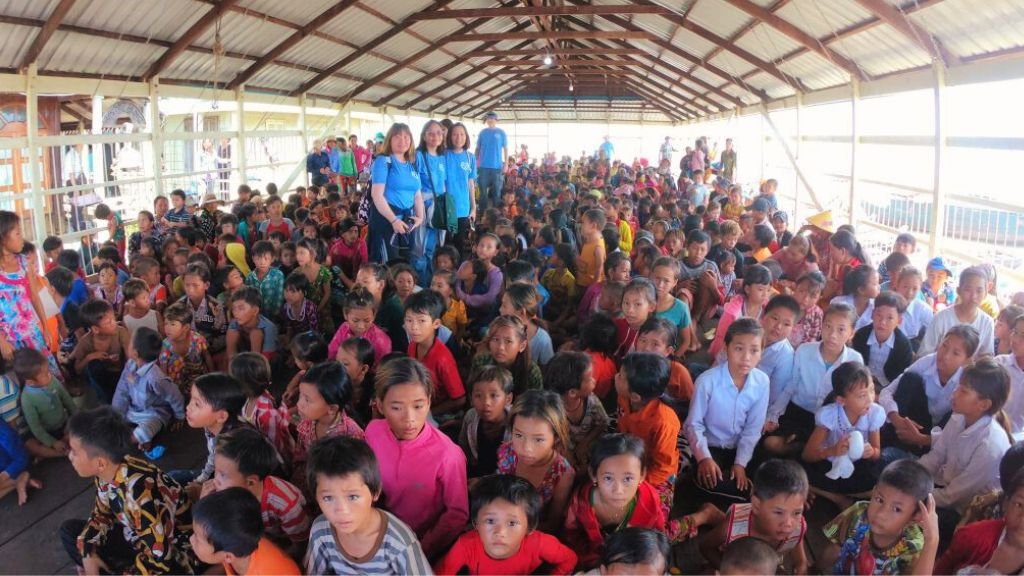
We worked two days in Svay Pak, an ethnic Vietnamese enclave infamous for child prostitution. Two days in Kampong Chhnang, the floating village with the largest ethnic Vietnamese population on Tonle Sap Lake and the site of recent fierce eviction and protest. And two days at Kampong Luong, the floating village deepest in the heart of the Lake and most difficult to get to.
Our gift-giving team distributed 1,000 provisions of rice and other essentials, and 8 heavy-duty poles to each family to stabilize 200 house boats being evicted from the Lake — totaling $25,000. This team, comprised of educators and students, also visited 4 schools and interacted with more than 200 local students.
Cambodia Medical Mission 2019 — amazing.
Vulnerable populations.
Exactly how large is this stateless population? No one knows for sure — and there is currently no accurate demographic data.

Based on individual accounts and reports from non-profit groups working in country, it is estimated to be about 1.5 million ethnic Vietnamese living in Cambodia — and about 800,000 living in floating villages scattered along the banks of Tonle Sap Lake and the Mekong River.
However, the most recent Cambodian Census, sponsored by the UN Population Fund and JICA, reported that only 0.4% of the population identified Vietnamese as a native language — totaling about 61,000 in a population of 17 million (UN/JICA census report).
It is nearly impossible to get a true number of this — by definition — undocumented and unwanted population.
We have to rely on what we know and what we see.
We know there are at least thousands of ethnic Vietnamese living in Cambodia, in the worst state of poverty and deprivation. How? We know because we have seen and served them.

We know they have no basic human rights — no right to find meaningful work, no right to a safe home, no right to quality healthcare, no right to education. How do we know?
We know because we saw children who have never received vaccinations. Kids who work cleaning fish instead of going to school. Toddlers who wander the streets while being "watched" by their grandparents as their parents go to find work underground. Teens who do not speak, read, or write in Khmer — and are primed to be trafficked into prostitution.
And because we know — we have to do something.
Now that you know — won't you join us?
Mai-Khanh Tran, M.D.
Founder and lead physician, International Humanitarian Missions, Inc.